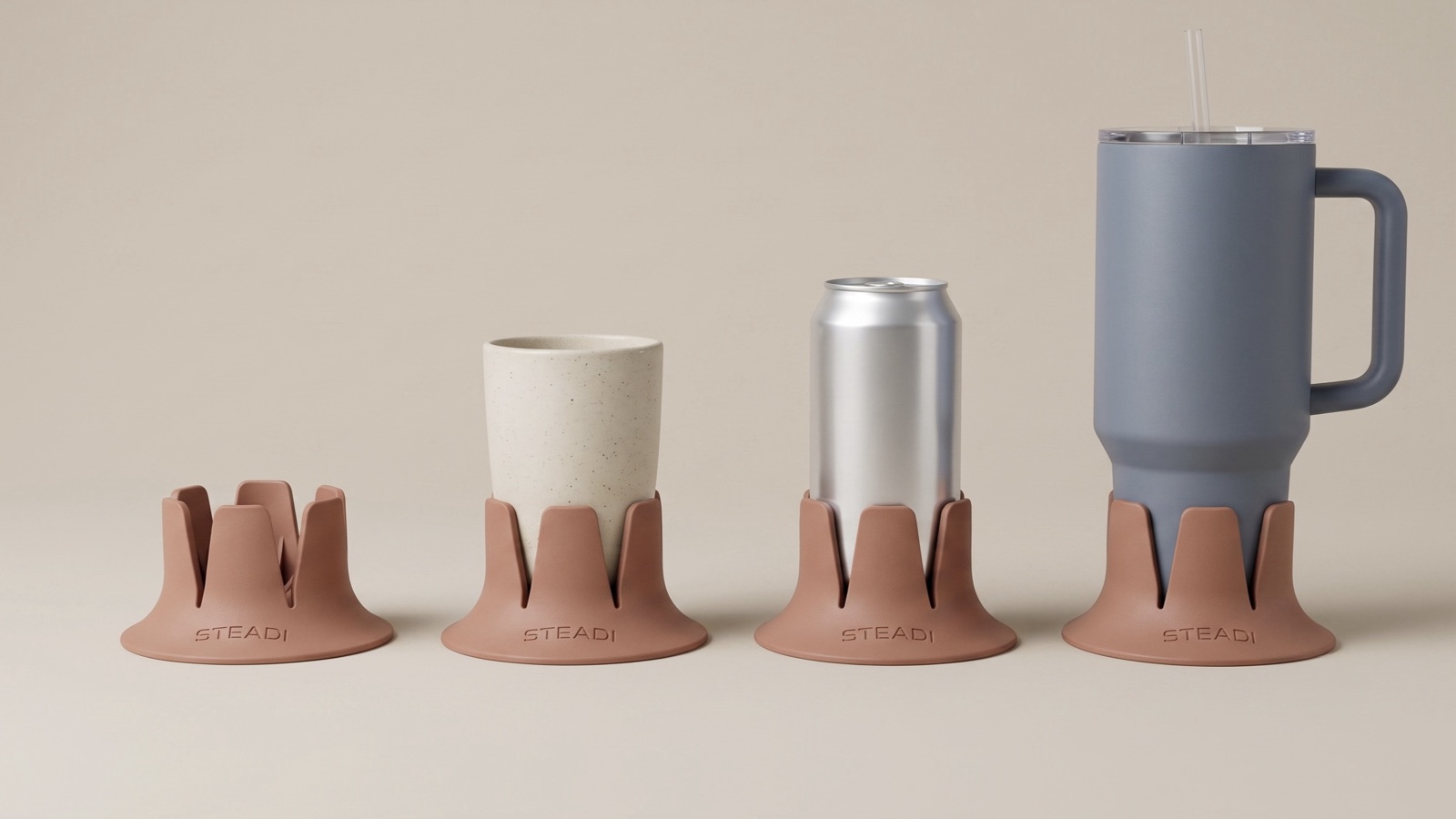
Finally, somewhere to put your drink at your campsite.
A flexible base that holds your can, cup, or tumbler steady beside the camp chair, on the picnic table, or next to the sleeping pad after quiet hours — on whatever the site's ground turns out to be: dirt, grass, gravel, or roots.
One flexible base. Set down empty, then loaded with a camp cup, a can, and a 40 oz tumbler — the same grip whether it's standing on dirt or on the table.
The situation
There's no real spot for your drink at this site.
From the first percolator pour to the last cup before quiet hours, the drink never gets a real place to stand — just a rotation of compromises around the site.
The chair's armrest sleeve.
Sewn into the frame around a bare 12 oz can — a 2.6-inch fit built for exactly one size. Anything insulated, anything with a handle, doesn't seat, and the fabric sags and squeezes whatever does go in whenever the chair frame flexes.
The picnic table.
The one surface at the site that's actually flat, so it's already carrying the stove, the dish tub, and the food bins before your cup gets there. Gaps between the planks and a table that's rarely level on its own feet don't help.
The cooler lid.
Slick with condensation, often domed instead of flat, and every drink parked there has to move the instant anyone wants ice — which at a campsite is constantly.
The ground around the fire ring.
Where everyone actually sits after dark, on packed dirt strewn with roots and rocks, with drinks at ankle height in the dark. A boot heading for more firewood finds a can before a headlamp does.
The tent floor.
Slick coated nylon stretched over whatever the ground is doing underneath, cluttered with sleeping pads — and a spill in here doesn't just make a mess, it soaks a bag that takes days to dry.
The trip survives all of it, easily. The bear box holds the food overnight; nothing holds the drink — chair, table, ground, tent, you re-decide at every stop, all weekend, and you've stopped counting how many times.
You know the moment
Same weekend, same five workarounds, every trip.
First light, before the site wakes up
The percolator comes off the camp stove and the first cup goes with you to the chair facing the sunrise — then sits tilted on a grass clump the whole time you're zipping your jacket.
Dinner, at the picnic table
Between the stove, the cutting board, and the dish tub, your cup gets shuffled from plank to plank all through the meal, straddling the gap where two boards don't quite meet.
Late-summer afternoon, second round
Ten minutes after the cans open, the yellow jackets find them. Everyone caps, covers, or just gives up on theirs — and by the second round nobody's sure which can was whose.
Full dark, fire ring
Every drink at the site is somewhere around ankle height, and somebody standing up for more wood finds yours with a boot before their headlamp does.
Getting up out of the low chair
You rock forward to lever yourself out, the frame flexes, and the armrest sleeve squeezes and dumps whatever it was pretending to hold.
What you get
Three reasons it stays out.
01
Stands steady on ground that was never going to be flat
The wide flexible base spreads its footprint across tufted grass, packed dirt, gravel, or hardpan instead of sinking a point into it the way a narrow base — or a chair leg — does. Soft, uneven ground is exactly the terrain it was built for.
02
Holds whatever the cooler run brings back
The can, the lidded bottle, the insulated tumbler, the plain camp cup — each drops through the fins and gets gripped by its bottom inch, no mesh sleeve deciding what size you're allowed to bring back to the chair.
03
Packs like it belongs in the camp bin
One piece of matte flexible material, no legs, no stakes, no hardware to lose in the dirt. It rinses clean at the spigot, shakes the sand or ash off, and folds flat into the camp bin between trips.
The fit test
Settle it at home, before the cooler's packed.
your cup's base lands in here
A square sticky note: 3 inches, exactly.
01
Grab a sticky note.
The standard square is exactly 3 inches on a side — that's a fact about sticky notes, not a spec sheet, and it happens to be the exact ceiling of what fits.
02
Stand the cup or can on it — right at the picnic table works.
Use whatever's actually going in the cooler or the camp box, and look at its base, not its rim. Tumblers taper and cups flare; the bottom is the only part that matters.
03
Read the square.
Base lands inside the square? It fits. Hangs over the edge? Too wide. A little puck lost in the middle — under about 2 inches? Too narrow.
No calipers at the site, no gear-forum thread, no guessing before you pack. One sticky note at the kitchen counter, with the cup you actually bring to the fire.
Will it fit my cup
Measure the bottom, not the top.
The rule fits on an index card: a container base about 2 to 3 inches across settles in. Everything below follows straight from that.
Standard 12 oz can fits
16 oz tallboy fits
Slim seltzer can fits
Stanley Quencher 40 oz fits
Yeti Rambler 30 oz fits
Lidded water bottle fits
Camp cup, no handle fits
Plastic cup, wine or cocktail fits
Kids' straw cup fits
32 oz wide-mouth Nalgene too wide
Enamel camp mug, handled handle in the way
There's a floor as well as a ceiling — under about 2 inches the base sits too loose. The wide-mouth Nalgene is the honest miss on the other end: a base that hangs over the sticky note is too wide. And the enamel mug is the classic exception — the base is fine, but the handle lands right where a fin needs to grip.
How it works
Three parts, no moving parts.
Wide beats narrow.
A chair leg sinks because it puts all its weight on one small point; grass tufts and packed dirt do the same thing to a narrow drink base. The wide flexible base spreads its weight out instead of pressing a point into the ground.
The fins hold on.
Inside the base, flexible fins take the drink by its bottom inch and grip from the sides, so a boot, a dog, or a dragged cooler bumping past doesn't rattle it loose.
The ground shifts; it settles back.
Someone scoots their chair toward the fire, the dirt gives a little underfoot, the whole site is never quite still — and the base flexes with it, bringing the drink back level.
Nothing drives into the dirt. No spike to stomp into ground that might turn out to be rock or hardpan under the topsoil, no clamp on the chair frame, no legs to level. No part of it cares what's underneath — dirt, table, or tent floor — and it moves when the chair circle shifts and folds flat into the bin when it's time to break camp.
The site, surface by surface
Six surfaces at a campsite, and not one of them is flat.
It isn't clumsiness. Everything at a site is sloped, sagging, crowded, or slick — and it's rebuilding itself the whole trip.
Grass and dirt beside the chair
Tufted with grass clumps and hidden roots, soft after dew or rain and hardpan by late summer — never actually level. A can set in grass rests on stems, not ground, and a nudge is all it takes.
The chair's mesh armrest sleeve
A sagging fabric ring sized around a bare 12 oz can, sewn into a frame that flexes with every shift of your weight. Campers online routinely report that insulated tumblers and anything handled just don't seat in it.
The picnic table
Around 6 to 8 feet of weathered planking with gaps between the boards, often warped or off its feet — and it's already doing triple duty as stove, pantry, and dish station before your cup gets a corner.
The cooler lid
Slick with condensation and often domed or ribbed instead of flat, at shin height right next to the car. Everything parked there has to move whenever anyone wants ice, which at a campsite is constantly.
The tent floor and vestibule
Slippery coated nylon over whatever the tent pad is doing underneath inside, bare sloped ground under fabric in the vestibule — either way, a spill doesn't dry by morning, it soaks straight into a sleeping bag or your boots.
The ground around the fire ring
Packed dirt strewn with rock and roots in a ring commonly 24 to 36 inches across — the social center after dark, with every drink at the site sitting somewhere around ankle height in the firelight.
Versus what you do now
What's already failed at your site.
The chair's mesh armrest sleeve
Built around a bare 12 oz can, so anything insulated or handled won't seat, and the fabric sags and squeezes whatever's inside whenever the chair frame flexes, folds, or gets leaned on getting up.
Clamp-on cup holders
They need round tubing or a proper arm to bite onto, and plenty of low camp chairs and hard-armed chairs don't offer one. Roundup reviews note they shift when the chair moves or the ground slopes, and they have to come off before the chair folds anyway.
Ground drink stakes
The spike-in-the-dirt fix only works where the soil actually accepts a spike — reviewers and roundups agree it won't drive into rocky ground or hardpan and wobbles loose in sand, which describes a lot of established sites.
The cooler lid as a table
Everything sitting on it has to move the moment anyone wants ice, the condensation makes the plastic slick, and plenty of lids are domed or ribbed rather than flat to begin with.
Before you buy
Questions people actually ask.
Does it actually work on dirt, grass, or gravel?
That's its home ground. Soft and uneven surfaces are what the shape is built for — the wide flexible base spreads across dirt, grass, gravel, or hardpan instead of sinking the way a narrow base or a chair leg does, and the fins keep the drink from rattling loose when the ground gives. Tilt what's under it and it settles back.
What about the picnic table or the cooler lid?
Yes — it works at least as well on a hard, flat surface as on soft ground. The wide footprint and the grip are worth having on a warped tabletop or a slick, condensation-wet cooler lid too.
Will my cup or tumbler fit?
Measure the bottom, not the rim. A base about 2 to 3 inches across settles in — the 40 oz Stanley fits. The wide-mouth Nalgene runs wider than that, and a handled camp mug won't — the handle lands where a fin needs to grip.
Does anything stake into the ground or clamp onto my chair?
No. Nothing drives into the dirt and nothing clamps to the chair frame or the armrest. It rests on whatever the site gives it, and it moves in a second when your chair migrates around the fire.
Which spot at the site does it actually work — chair, table, or tent?
All three, on the same footprint. Beside the chair on dirt or grass, on the picnic table when there's room, or on the tent floor next to your sleeping pad at night — it doesn't need to know which surface it landed on.
Does it keep the yellow jackets out of my drink?
No — it isn't a lid. What it does is get the can up off the ground and out of the grass, so it isn't sitting where ants and drifting ash find it either. Late in the season, pair it with a lid or a covered cup for the sugar problem.
My chair is low and I have to rock forward to get out of it — does that dump the drink?
Only if the drink is riding the chair, which is the quiet flaw of the armrest sleeve. This sits on its own wide footing on the ground, so the chair can flex and lean all it wants. It resists tipping and settles back when bumped — it isn't magic, so a direct kick from a boot in the dark is still a direct kick.
What about inside the tent?
That's a quiet win. The floor is slick coated nylon, so a knocked-over bottle travels instead of soaking in. Standing it in the base next to your sleeping pad means the middle-of-the-night reach finds it upright. It isn't a sealed cup, so keep using a lidded bottle overnight for the second layer.
Does this only work at sites with a picnic table?
No — it doesn't need one. A walk-in site with nothing but a fire ring and a tent pad, or a dispersed site off a forest road, still gives it ground to stand on; the picnic table was never doing the real work anyway.
How do I clean it after a dirty weekend?
Shake it out, rinse it at the spigot, or run it through the dishwasher at home. It's one piece of injection-molded material — no fabric to fray, no screw to work loose, nothing to come apart in the bin.
Who makes it, and where do I buy one?
It's called the Steadi, molded in small runs in Orange, California by Steadi Labs — veteran-founded and patent pending. Every order ships free from steadilabs.com, with 30 days to change your mind.
Who makes it
Made start to finish in Orange, California.
The maker is Steadi Labs, a small veteran-founded company in Orange, California. It's injection molded — the mold, the material, and the color runs all sit within about three and a half miles of the shop, and every batch is molded there in small runs. The people who make it are the same people who answer hello@steadilabs.com.
Thirty days, wherever you use it.
Use it for a month. If it doesn't do what this page says, email hello@steadilabs.com and it gets made right — no forms, no fight.
Veteran-founded · Patent pending · Made in Orange, California
Give the drink a real spot at the fire ring.
Coffee stands by the chair at sunrise, the can survives the firewood run after dark, and quiet hours arrive without one more thing tipped over in the dark.